Thursday, 13 August 2015

Our Italian Adventure: Part Quattro - Meeting the World in Milano

    It has been a hectic few weeks since I last updated this blog. I finally have the time to now present the last installment to "Our Italian Adventure". After wandering around Tuscany and Florence, we found ourselves back on the Freccia Rosa, travelling towards Milan. Milan was to be our final stop. Most people, the Italians themselves included, would raise their eyebrows when we tell them that we would spend the next few few days in Milan. "But there's nothing there to see," would be the usual refrain. This year things are different. This time, we're going to Milano to meet the world...

World Expo 2015: Milano

    This year's World Expo is held, yes you guessed it, in Milano. Actually in a suburb, a train's ride from the city center. The World Expo consists of pavilions from 145 countries, 3 international organizations and a host of other NGOs and commercial companies. The theme this year is "Feeding the Planet, Energy for Life." Being the foodies that we are, we anticipated that this year's expo would be interesting. We first headed to the Italian pavilion, which was one of the largest. We figured that the host nation would have one of the best around. After a long wait in  a snaking queue, we found that this was not the case.
Nutella pop-up concept store
    Two notable pavilions were those from Israel and Japan, Israel's was the epitome of "minimal effort, maximum output." They made the best use of interactive video technology to present a multimedia showcase of how they managed to first make the dessert bloom, and then export their technology to benefit the rest of the world. Do you know that cherry tomatoes are an Israeli invention? I was taken by the similarity of the Israeli work culture as compared to Singapore's. Both value efficiency to the extent of being clinical. Both are pragmatic to the extreme. I believe it is this work ethic that allows for the success that both enjoy.
    The other note-worthy pavilion belonged to Japan. True to their culture, the Japanese's presentation was tip-top, high-quality and no effort spared, from entertaining the people in the queue down to the very exhibits themselves. Similar to the Israel, Japan made excellent use of multimedia technology. The centerpiece was a rendition of their concept of the future restaurant. "Guests" (that means us), were treated to a "meal", with entertainment at the Japanese future restaurant.
walking through multimedia grass from Japan
Future restaurant
    Besides the various country pavilions, we also got to experience a future supermarket. Here details of every item are displayed on LED screens when one points to the item. Such information can really come in handy when deciding which type of food or which brand to buy from. Details include, the source of the ingredients, the carbon footprint used to produced the item, and whether it is organic or not. The checkout process was also fully automated.
Our trophy from the World Expo
    One thing I found disconcerting about the World Expo was that most of the countries were more interested in showcasing their food. Most presented no solution to the main issue, which was to feed the planet and create sustainable energy. Take the Vatican for example. The Holy See was only interested in showcasing it's charitable arms. What it offered was simply for the world to recognize where it "went wrong" and to pray. Iran was even worse. I couldn't care less about the "great" historical figures they showcased. Even the better pavilions, such as Japan, had no real idea of how they could contribute to the future betterment of the planet. Only Israel stood out with practical solutions to meet world hunger. In the end, as fantastic as it made itself out to be, in my view, the World Expo had more entertainment value than to be of any practical use.

Art and Culture

    Contrary to popular belief, there is lots to see and experience in Milano. No visit would be complete without a visit to the Duomo. We didn't climb the dome this time. Nevertheless, the facade and main sanctuary provided a feast that was more than enough for the eye.
Did Frédéric Auguste Bartholdi get his inspiration for the Statue of Liberty from the Milan Duomo?
Giant columns holding up the roof of the Milan Cathedral. They were designed to resemble giant cedar trunks, giving the sanctuary a sense of natural tranquility. As one's gaze follow the row of  forest trunks, one is led to the alter, which is the focal point. If you look closely enough, you can spot a red light slightly below the crucifix. This indicated the box which supposedly contains one of the nails that pierced Jesus during the Crucifixion.
Keystone representing the head of God the Father - cathedral museum.
     Besides the Duomo and related buildings, we also explored Sforza Castle. It is here that a entire room decorated by the great Leonardo Da Vinci is being restored and Michelangelo's final Pieta is housed.
Milan - fashion capital of Italy. How can we leave shopping out? In a way, shopping is part of the tourist culture in Milan.
Local Tradition - Stepping on a certain spot of the Turin Bull for good luck.
Galleria Vittorio Emanuele II - where history and shopping meets
Visiting the Navigli Canal district
Food Glorious Food

    When it came to food, Milan did not disappoint. Introducing the World Expo Limited Edition McAngus Burger and Lobster Panini from, of all places, McDonald's!
Fancy having a meal on a farm in the heart of the city? "Un Posto A Milano" would be your best bet. This 1700s farmstead now hosts a kitchen, bar, and even a guest house. Feast your eyes...
Which trip of ours would be complete without going for a Michelin starred meal? This time the wifey chose "Al Pont de Ferr" situated on the banks of the river. This nondescript restaurant hides it's identity really well. We could've walked past it if we weren't purposely looking out for it. Nevertheless, its Michelin Star is truly well-deserved. The excellent quality of food was a given. What was more surprising was that this was the least expensive meal of our entire Italian trip!
Foie gras with olives soaked in martini anyone? Potent!
I simply love the pumpkin rolls. Finished both of course.
Crazy Wheels pasta
We decided to take a stroll around the district after a more than hearty lunch. Just around the corner we stumbled on this gelateria. At first we were totally confused by the variety of ice-cream available, Thank God for kind grandmother who was buying ice-cream for her grandchildren. She explained the different flavours to us. We settled on "noblesse". Smooth sticky chocolate. Absolutely yummy. The only other gelato that gives this a fight is the one at Dubrovnik. Interestingly, this is the first time we came across this flavour. And we've never come across this flavour ever since. Definitely a must try.
To round off our Italian adventure, we decided to have dinner at the restaurant around the corner from our hotel. We had dinner here the night before and were taken by the size of the veal fillet. We had to give it a try. The picture does't do justice to the size of this fillet. It was nicely breaded, thin yet juicy enough to provide a good mouthful.
The maitre 'd offered us some limoncello to round up our meal. I'm not much of a drinker, so at first we declined. Moreover, we first tried the liqueur in Rome a few years ago, and it tasted absolutely horrible. However, the kind man pressed us  and offered "two drops". We couldn't turn down his generosity and relented. The "drops" turned out to be two glasses. I took a sip and was pleasantly surprised by the sweetness that greeted my palate. It was totally different from the one we tried in Capri (or was it outside Pompeii?). Another sip and the warmth hit me like a tonne of bricks! The sweetness masked a potent punch. Even the wifey who prides herself on having a healthy tolerance for alcohol went soft as fabric under its spell. We stumbled our way back to the hotel. Thankfully it was only across the road.

    It was indeed an apt conclusion to our adventure in Italy. Stay tune for our next adventure, coming up in a few weeks. This time,we head to Switzerland!

Wednesday, 15 July 2015

Our Italian Adventure: Part Tre - Trailblazing in Tuscany

 Pisa

Wifey's lunch: large chunks of porcini mushrooms!
   What Tuscan holiday would be complete without a trip to the university town of Pisa? Pisa is a convenient train ride away from Florence. No prior planning is needed. Purchase a ticket at one of the ticketing machines at the Santa Maria Novella station and you'll be on your way. We arrived at the Pisa station and made our way across the Arno River into the historical part of the city. Stopping for lunch, it is here that the wifey had her first taste of cantuccini. This consists of twice baked (to harden and dry the dough) cookies (also known as biscotti) which is dipped into sweet desert wine and eaten as a desert. We were expected to finish the wine as well. However, even the wifey, who usually could down a few glasses, found it tough to finish the alcohol.
Cantuccini.
    Pisa is in fact a quaint town worth spending some time exploring. However most people would head straight to the it's main attraction - the "leaning tower" in the Piazza del Duomo. The attractions in the Piazza include the Cathedral, Baptistery, the Campo Santo (walled cemetery), and of course the leaning Campanile (or bell tower). Don't bother fighting for space to take pictures immediately when you reach the Piazza. A better vantage point can be found behind the tower, in front of the ticket office and gift shop. In fact, this little piece of meadow doubles as an excellent picnic spot.
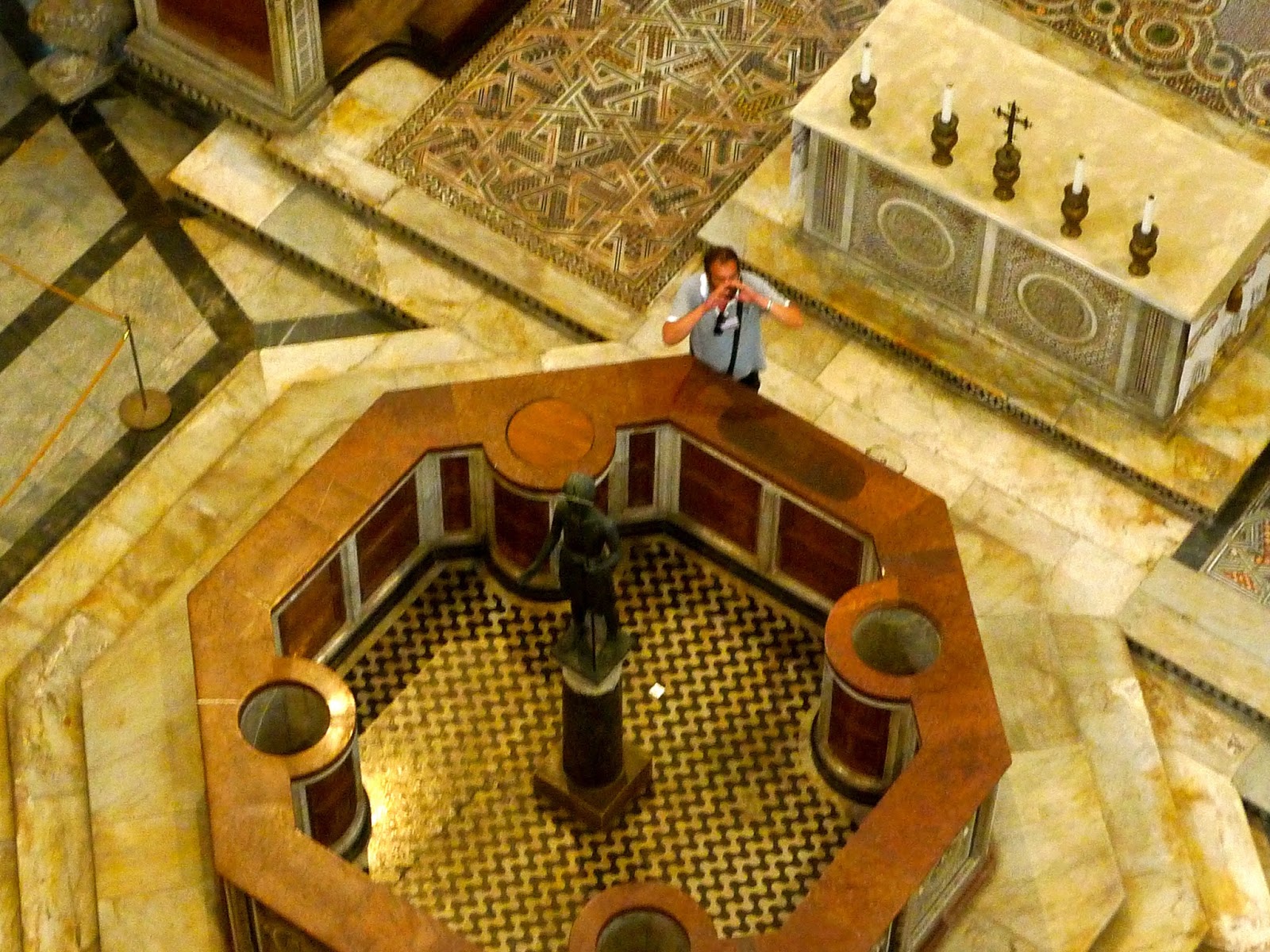
View from the 2nd floor of the Baptistery.
     The entrance to the Battistero di San Giovanni (Baptistery of St. John) directly faces the cathedral. It has been suggested that this symbolized the welcome of the initiate into fellowship with the rest of the congregation after the ritual of Baptism. A fact that many tourist would miss, is that every half an hour, a guard will demonstrate the excellent acoustics of the Baptistery by calling out from the center of the monument. It was indeed a eye-opener (ear-opener?) when his voice traversed around and around the vast interior. It was as if a choir of angels were present - yet all originating from the vocals of one person.
Guard demonstrating the excellent acoustic quality.
    We spent the rest of the day walking through the town, enjoying a cup of cappuccino, and dog-watching (the dogs here are more entertaining than the humans). 

    Choosing Florence as our base was a strategic decision. This allowed us to venture out to the rest of the Tuscan countryside (besides Pisa). We duly booked a day trip to explore the rest of this picturesque region. On the way out we even traveled through the Carrara region and witness the white mountains where Michelangelo sourced his marble. I'll let the photos speak for themselves...

San Gimignano

    This walled medieval town is famous for its towers. It is not surprising that San Gimignano is also known as the Manhattan of the medieval world. Wealthy families sought to outdo each other in this extravagant show of affluence.
Towers in the background.
View from the fortress at the top of the town.
Raw white truffles. And they are REALLY CHEAP!
We'll go truffle hunting next time.

Chianti Region 

    We were introduced to the region of Chianti and it's wines (the Chianti Classico, Chianti Classico Riserva, and the Super Tuscan). The best Chianti wines are labelled with a Black Rooster. Legend has it that in the 13th Century, rival cities Siena and Florence decided to end their war with a race. Two soldiers were to race at dawn (when their rooster crows) from their respective cities. The meeting point was to be the border. The Florentines kept a black rooster in a box for days without food. On the appointed dawn, this rooster sang out much earlier (supposedly from hunger). Thus the Florentine soldier set off much earlier. In fact, the two met only 20 km from the Siena's walls, handing a resounding victory to Florence.

Siena

Flags of the 17 Contrade.
    This city has been a long-time rival of Florence. Besides militarily, they competed for influence over trade and culture. Unfortunately for it, it lost out eventually. Nevertheless, I feel that the Duomo here (although never completed according to the original grand blueprint) beats that in Florence. Siena also has something that Florence will never have - the annual Palio de Siena. This is a bareback horse race dating back to medieval days. Riders representing seventeen Contrade (city neighbourhoods originally formed as battalions for defence. Reminds of the "districts" in Hunger Games) vie for a trophy (a painted banner with the image of Virgin Mary).
Town hall and Piazza del Campo in front of it.
The Duomo
Grand interior.
Siena - centre of Italy (or so it fancies itself)
Besides the Palio, Siena is also known for its art (i.e. the Sienese School)

Monteriggioni

    This was our final medieval town of the day. We first spotted the town from a distance. It's imposing walls rose from the horizon like something out of the Lord of the Rings. The coach pulled into the parking lot and we had to make our way up a somewhat winding road to the top of the hill. This was where the town of Monteriggioni sat. When we finally reached the town walls, it didn't look that intimidating. In fact, the town proved much smaller than we thought at first. The little piazzas that dotted this place gave it a fairy tale-like atmosphere. It was almost "dainty".
Last stop.
    Here ends our adventure in Tuscany. Next, we were on to Milan. Stay tune...


Our Italian Adventure: Part Due - Careering around Cinque Terre

    Being the beach bum that she is, it wasn't surprising that the wifey planned a day trip out to Cinque Terre (pronounced "chin-kway-teh-rey"). Cinque Terre consists of five sea-side villages, located in the region of Liguria and near the town of La Spezia. The whole Cinque Terre National Park, consisting of the villages, adjoining hillside and  coastline, is a Unesco World Heritage site (yes, another one under the belt).
    As the tour bus neared the first town, the terrain began to slope upwards. Wasn't this supposed to be a coastal village? What were we doing, going up into the mountains? My doubts were soon relieved when we disembarked and made our way down (literally) into the first village - Manarola.

Railway station in the far background.
    From Manarola, we took the metro to our next stop, Corniglia. As the train pulled into the station, the village was nowhere to be seen. It was soon pointed out to us that Corniglia is situated at the top of the nearby hill. We then commenced the climb. What a climb it was. I fancy myself to be in pretty good shape (afterall, I do work out regularly and the doc said my heart was in pretty good shape) but soon my tighs were burning with the exertion and perspiration pour down my brow. The guide wasn't joking when he said we had to "work for our lunch". Unbeknownst to us, it was a precursor of tougher things to come. We ambled through Corniglia and arrived at a little hill-top restaurant with a fantastic view. Lunch was then served.
Lunch
    With our bellies satisfied, we soon found out why we were served carbohydrates. I knew that there was a trek somewhere in the schedule but I never expected what was to follow. We were supposed to trek through the mountains to the next village. The guide told us that there were once three elderly women who had too much to drink during lunch. In the end they took almost three hours to finish the trek. We were soon on our way.
Happy faces before the climb. I never expected what was to come.
Leaving the town behind (you can see it at the far left of the
picture. Tiny tiny far away...)
    The route started off pretty innocently at first, just a casual climb, not unlike something you'd experience on Bukit Timah Hill. Then the terrain started getting steeper and more rocky. We were no longer stepping on forest floor. Every step we took was cut into the rocky face of the mountain. At times, the path could only fit one person. The alternative to waiting for your turn was a flight down the mountainside to certain demise. It didn't help that the sun was beating down on our heads mercilessly. Each new step seemed more torturous than the one before. Soon my legs began to cramp and I felt a tongue of headache approaching. The one litre bottle of water I had in my backpack felt like a tonne.
Eking out a smile... Press On! 
The wifey on the other hand, skipped ahead, as if on fairy wings. In the glare of the noonday sun, it almost looked as though she had Hermes wings on her feet.
The view on the way was actually quite calming, if not for the terrain and the sun.
     No choice; turning back was not an option. Endure. Press on. I was reminded of the time I spent in National Service (NS). One thing I'd learnt was that the human body could take much more punishment than we ever imagine. One step after another. Finally in the distance there arose the faint silhouette of a tower. The rest of the village soon crept into view - civilisation at last!
Civilization at last!
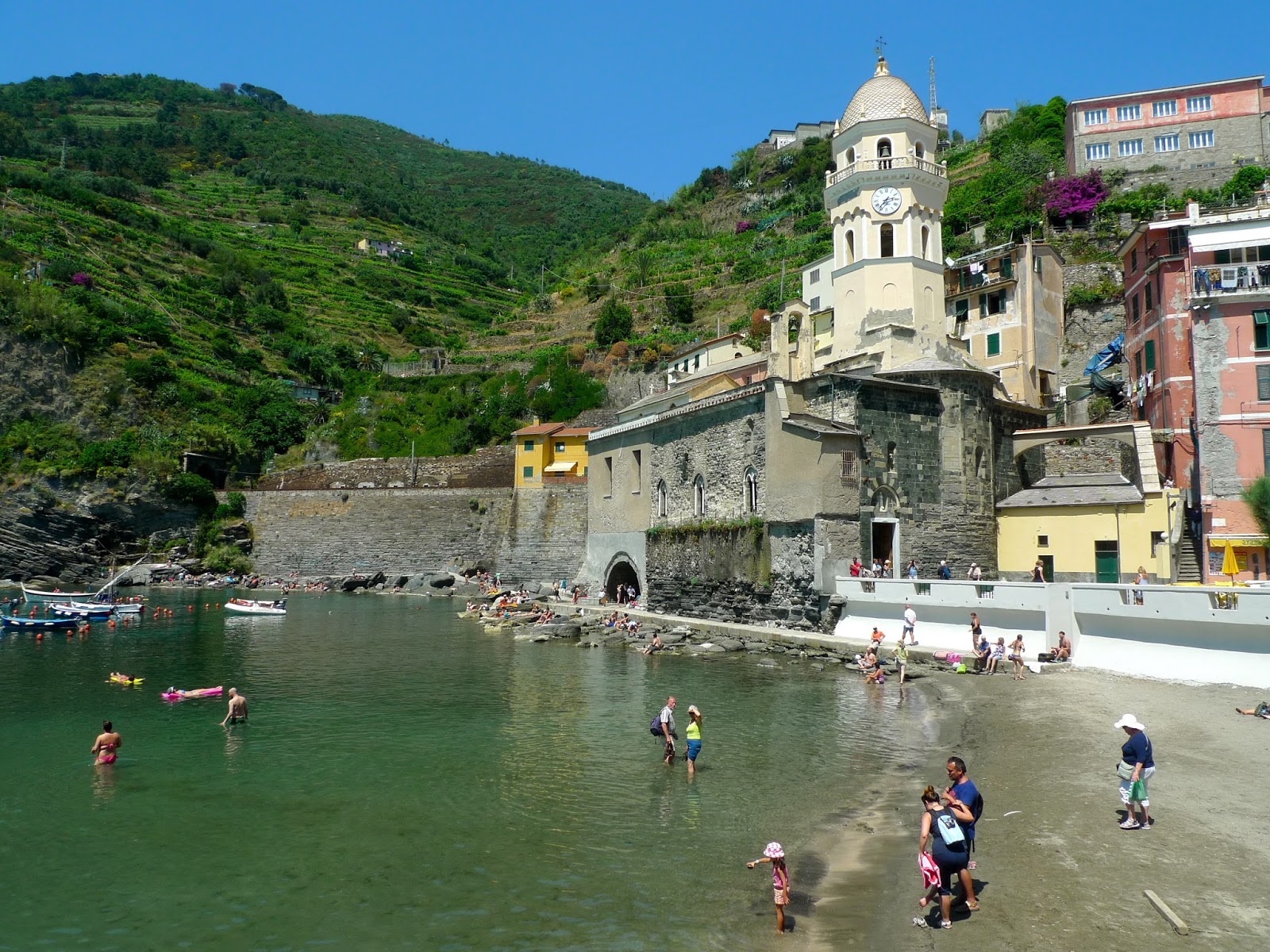
Down through the narrow streets of Vernazza, between multicoloured residences we went. Straight down to the quayside, to one of the most popular attractions in the village, the gelato shop. It tasted like heaven. It was here that the wifey decided to enjoy the pristine waters of the bay. Then off we went again, by metro to Monterosso al Mare.
The quay at Vernazza.
Monterosso: the most touristy of the lot
The approach to Riomaggiore.
    Our final stop was Riomaggiore. This time we approached by ferry. The ferry hugged the coastline as we slowly made our way to our final stop. Suddenly the bare hills broke out into colour. It was as if the red yellow and blue of Riomaggiore was flowing from the green mountain behind, towards the sea, just stopping short of the beach. It was sight to behold. It is at this busiest village of Cinque Terrestrial that we found the most delicious calamari. The fried anchovies and fish slices were excellent too, but it was the calamari that took the cake.
Some of the best calamari in the world.
     Then it was back on the train, to la Spieza and our tour bus. And that was how we spent a day at Cinque Terre.

Friday, 10 July 2015

Our Italian Adventure: Part Uno - Frolicking in Firenze

    Rolling pastures and sun-scorched greenery greeted the eye as the train rushed headlong into the heart of Tuscany. It wasn't long before we arrived at the Santa Maria Novella station in Firenze (Florence), Italy. Thanks to the ingenuity of the wife, our home for the next week was situated right smack between the train station and the historic heart of the city; from here we will venture forth on this new adventure.
View from our balcony.

Florentine Art, History, & Culture

    After a night of much needed rest, we were up early and all ready for what was to be a crash course in European art history. First stop, the Uffizi Gallery. This museum showcases the art collected by the then powerful House of Medici. From here we can trace the evolution of art, from the Middle ages, followed by the Renaissance, the Baroque, Neo-classical stage, and finally the art that we have closer to the modern day (such as the that of the impressionist movement). We were taught how to differentiate art from the Middle Ages from that of the Renaissance.
An example of a sculpture from the Middle Ages: Very stylized, expressionless, poised as if taking a formal photo, restricted within it's niche.
Now contrast the above with another sculpture on the same facade of the same building. Renaissance: fluidity of movement, harking back to classical Greek and Roman statues, partly outside it's niche - drawing the viewer into the work.
Michelangelo's Holy Family: an example of late Renaissance art attempting to "explode" into the Baroque.
   
Entrance to the Vasari Corridor
The tour culminated with us transiting through the Vasari Corridor. This "secret" passage starts behind an unmarked door and runs across the Ponte Vacchio, connecting the Uffizi Museum to the Palazzo Pitti, on the opposite bank of the Arno River. This corridor allowed us to travel above the heads of the crowd below. More importantly, this corridor houses the largest gallery of self-portraits in the world. Masters from the Middle Ages all the way to the more recent impressionists.
Vasari Corridor
Looking down on unsuspecting people on the Ponte Vacchio
    If you do go for this tour, try to end it before reaching the Palazzo Pitti. This allows you free access to the Boboli Gardens behind the palace. Such was what we did. Although the guide books extol the Boboli Gardens as the inspiration for other European gardens such as the one at Versailles, we found it a tad disappointing.
View from the top of the Boboli Gardens, city in the distance.
    The main attraction of Florence is arguably its Duomo and the surrounding architecture. This complex consists of the cathedral at the center, surrounded by the bell tower, baptistery and other religious buildings. There's no point climbing both the bell tower and the Duomo's cupola as the viewers are almost identical. Our first stop was the bell tower as we didn't want to squeeze with other tourists that were expected to flood the area later in the day. Another tip for would be travellers; visit the Baptistery first if the queue to the main cathedral is too long.
Climbing Giotto's Bell Tower, up the 414 steps
View from halfway up the tower
     Besides the Uffizi Gallery, another place art aficionados should not miss is the Academia. What I appreciate about the Florentine art museums is the conciseness with which the works are displayed. The Academia is no different. It only takes a couple of hours to take in all the art. I totally agree with Shakespere that a "surfeit of the sweetest things, the greatest loathing to the stomach brings". We bought reserved tickets a few days before. Don't be fooled. Even with reserved tickets, we still had to join a queue. Albeit, the queue was the shorter one.
Michelangelo's David
    It is here that we admired the original Michelangelo's David; in all 4m of unclothed glory (do not confuse it with the pretender standing in Piazza Vacchio, outside the Palazzo). "Amazing" doesn't start to describe this incredible piece of Renaissance work. Every muscle, sinew, vein and hair is described as realistically as marble allows. Unlike other classical sculptures, Michelangelo did not over-emphasize the subject's musculature. You can almost imagine David's marble skin being sheer, soft and malleable. The wife was so taken by this piece that my state of fitness might now forever be compared to that of an inanimate stylized sculpture.
    On a different note, there is a lesson we can learn. David was formed from a slab of marble abandoned in a church yard. Yet this forlon piece of stone, when placed in the hands of the master craftsman, was transformed into a masterpiece that is enjoyed by thousands, for centuries to come. If we are willing to surrender ourselves to the Lord, I believe He can make us into something beautiful too.
    Another work of note that can be found here is the second of Michelangelo's three Pietas. The Palestrina Pieta seems unfinished and indeed it stands along with other unfinished Michelangelo sculptures. (Note: although attributed to Michelangelo, no one is certain of its origin or the sculptor)

Food, Glorious Food

    The "bang bang" of metal against bone and wood will assail your ears when you enter any Florentine restaurant worth its salt. These places sound as much a butcher shop as eateries. The reason for this is of course the Bistecca Florentina - Florentine Beefsteak. This monster of a T-bone steak is usually served medium rare (emphasis on rare), in portions of at least 1kg.
The wifey's favourite dessert at La Sostanza
Roast chicken and traditional white beans
    Florence is littered with many small restaurants. As a rule of thumb, we'd not enter one that provides "menu touristico". We're here for the local and authentic. Drop by into one of these quaint shops and you might be surprised to find that it actually is an award-winning establishment that even the locals patronise.
Florentine Tripe - yes a whole pot of tripe. Definitely a Must-try.

Oooo look at that
   We had wanted to try this restaurant that was recommended by the Hotel, Mama Chinta (or something like that). But it was closed when we got there. No worries, just hop into the next restaurant down down the road. Boy did we find a treasure trove. The place: Osteria Del Cinghiale Bianco. This osteria is located across the river from the main tourist sites. Cross the Ponte S. Tranita, right of Ponte Vacchio (if you face the river with your back to the Uffizi). Excellent food at super afforable prices. Where can you find shaved truffle on buffalo cheese, porcini tagliatelle and dessert at less than 50 Euros?

The Green Rom of the Santa Maria Novella Pharmacy
    One place that defies categorisation, yet must be mentioned, is the ancient Santa Maria Novella Pharmacy, the Officina Profumo Farmaceutica Santa Maria Novella. Originally part of the cloister compound of the Santa Maria Novella church, the entrance is now found along Via della Scala (no. 16), around the left corner of the Grand Hotel Minerva. Established by the Dominican friars of the church in 1221, the pharmacy became famous for its salves, fragrances and skincare products. Today the pharmacy is in private hands. Even with the advent of modern methods, each batch of products is still hand-made and supervised according to age old recipes and artisanal methods.

    From Florence, we took day-trips out to the surrounding Tuscan countryside. But's that's another story for another time...